2:58 PM (20 hours ago)
Hi Faith,
I have reviewed your MA Project and I would like to discuss it with you. No problems – I just want to explore a few things. The document is remarkable in many respects. Could I call you tomorrow, Saturday, any time? Thanks, Bob
10:37 AM (4 minutes ago)
I am willing myself to not be anxious about this phone conversation, and – really – I do feel fairly calm.Perhaps there will be revisions requested, maybe a re-write. I don’t know if I will take something like that on, or if it is an option for me to take something like that on. I might not have to, for the purposes of the project in the immediate.Eventually, I will need to re-write the entire thing, and – come to think of it – I am excited about the prospect of revisiting the work, not for the purpose of satisfying degree requirements, but for the purpose of refining the way I tell this story, which is the only story I have to work with, save for stories I might make up.I may have to make up stories to tell parts of this story – give the characters fictionalized personas, different names, different places.In working on this project, I realized a few very important things.The most prominent of these, in my mind, is the understanding that, yes, I really was crazy at a few points. I was not aware of what I was doing in appropriate reference to the world around me, the other people in my life, my self and established identity. Further, I was inhabiting a reality that – while some elements were potentially actual – simply was not real, at least not in the details that I believed in.I think, for a long time, my instinct has been to try to somehow prove that I was not crazy, or to somehow justify my craziness. In a lot of ways, my experience of psychosis was justified.It wasn’t random. It was a result, a critical outcome.I still am crazy, but I am also alright.In working on this project, I have come to understand why my family was so concerned, so panicked. I knew, conceptually, that they were not seeing me clearly, and that they were worried and that it was hard for them ot know how to help me. In seeing myself here, as presented in this project, I understand a little more – in my heart – how terrible it must have been for my father to have that conversation with me in the parking lot.I was being extremely weird, not stable.Part of me whines about my right to be weird, to indulge in emotionally-driven and impulsive whims.I don’t think, however, that my family should have to worry about me.Why didn’t it matter to me that my father got worried when I talked about postmodernism? Why did my right to talk about things that I find interesting supersede his right to be communicated with in a way that wasn’t baffling and worrisome?I have kids and three loads of laundry to put away. My geriatric pets demand a high level of care.Yesterday, I got home from work at 7:00pm, a whole day spent at the state-funded recovery education center and on the road. I took care of dogs and ran interference between cantankerous and hyperactive pets and cleaned up after dogs until 9:30pm.It was Friday night.
I got this message about a Phone Conversation, and I went outside to pull bindweed and kudzu. I discovered a new mimosa tree in the wild space between my neighbor’s house and mine.
I wrote myself email about killing kudzu, the beginning of an essay that I may or may not complete.
My arms are itchy and my hands are covered with small cuts and scrapes. The vision in my right eye is blurry and I can’t stop blinking. I can feel that there are small shards of broken trees and scraps of leaves in my shirt. I sneeze, and look around, a little dazed by the sagging heaps of biomass around me, mounds of tangled vines and sharp sticks, entire small trees, split from the earth at the trunk. I couldn’t find the hedge clippers. They had become buried in kudzu.It’s that time of year again, when you look up one afternoon and catch sight of the first few truly stretching tendrils of furred vine dancing out into the breeze, reaching for the next branch. You see that the top of the hedge has already been covered, the small trees at the back of the lot already tangled with secondary and even tertiary growth. It’s almost like it happened over night. One day it isn’t there, only the dried grey withered ropes of last year’s vines, and the next day it is, twisting up the remnant’s of its own old growth.We didn’t really even notice the kudzu when we moved in. It seemed to just blend in to the hedge, or it didn’t register with us, in our state of new-home-adoration, that, “Hey, that’s a ton of kudzu, right there. Growing up onto the house.”It clung to the windows, and snaked up the siding, leaning over from the old skeleton of a hedge, now a sinewy mass at least five years thick, the oldest vines crumbling to a thin dust at the very core, the outer vines still showing green, last year’s first year growth spawning this year’s production, the season’s accumulation.We thought it would be easy at first, to kill it, to clear it off.Sent from my BlackBerry 10 smartphone on the Verizon Wireless 4G LTE network.
____________________
I looked at this project again. My God, the glaring errors. Where was my mind when I was working on this?For the most part, work on this project has taken place in fits and bursts, long trudges of staring at screens and scrolling pages past 10:00pm, my eyes literally crossing from fatigue, dogs chewing their hindquarters on the couch beside me, because I still don’t have a proper workspace for writing and art, because of the conundrum of time and energy to maintain and energy to create, to change, to clean my desk and paint my room.I have tried so hard to build a life, and it’s all just jumbled and overgrown.There is a therapeutic element to this project, but I never wanted it to only be about me and my healing, my sense-making.On Friday morning, I woke up to a message that my friend, who is only briefly here, in this project – but, who was such a massive part of 2011 and onward, until – only recently – they were not…that my friend is in jail.This person was, at one time, the most brilliant person I have ever known, genuinely gifted and golden. Over the course of the past 5 years, this person has lost a brother to suicide, and survived multiple encounters with compulsory psychiatric care, because they have had an increasingly difficult time modulating their realities, and are prone to alcohol-exacerbated foibles and foolery in public spaces. The last time I talked with them, they thought they were someone else, this person who – for a time – was my best friend, my true friend.Now, this person is in jail, a detention center in a place named Rancho Cucamonga, and I just can’t help but to wonder if something had been different in my friend’s life, if they would have known more joy, more freedom?Well, yes, of course if something had been different their life would be different. It might have turned out worse than it did, but what might have improved the odds of a favorable outcome?So, this is not only about me and my healing, it is about all of these other people, friends and people I never even met who have gotten lost and hurt and who have died because of who they are and how they are and what happens in the space between their minds and their hearts, and the world.The treatment of psychosis is important. I do not think that compulsory mental health treatment is helpful. Helping people to understand themselves and to understand how their mind works, how it puts together realities and sensitivities, how to heal from dark trauma…helping people to contextualize these experiences and to not be isolated in them…these are things that I believe are helpful.I have to keep trying to gain the skills to be able to help change ideas about what psychosis is and how it is best treated. There is so much amazing work that is happening around the world. The Hearing Voices Network and Open Dialogue and first episode psychosis programs and psychosis-specific peer respite programs – all of these things are shifting the practice and theory that surrounds psychosis.There is also an enormous amount of research being done on the neurophysiological processes associated with psychosis. From what I have seen, there are some murky relationships of causality in this body of research. For example, in National Institute of Health-funded research investigating epigenetic markers for schizophrenia, it was found that there is a shared epigenetic trait among people with bipolar disorder, schizophrenia, autism, attention-deficit disorder, and major depressive disorder.National Institute of Mental Health, (March 1, 2013). Five major mental disorders share genetic roots: Overlap blurs diagnostic categories – NIH funded research. Science News. [online report]. Retrieved from http://www.nimh.nih.gov/news/science-news/2013/five-major-mental-disorders-share-genetic-roots.shtml.Is it possible that perhaps this is not a marker for mental illness, but a marker for a variation in being human, or an epigenetic change caused by atypical antipsychotics, which are well-known to be heavily prescribed across these five diagnostic categories?I wonder if there are epigenetic markers for certain forms of cognition, sensitivity, and intelligence?I am interested in surveying the literature pertaining to the intersection of cognitive and sensory processing styles, creativity, and psychosis. I want to learn about practices and theories that integrate understanding of tendencies in thought, conceptualization, and experience through awareness of individual variance in cognitive/sensory processing.As for my own cognitive processing, working on this project helped me to see that – whoa – I am slipping, at least that is the assessment that could be made, based on chaotic and errored assemblages, sloppy referencing, unfinished thoughts.I think that working on difficult projects is best done when one is well-rested and clear-headed, not when one is addled by dogs and long drives and dinner and dishes to be done.In this next chapter, this next phase of this long project, which probably started – very quietly – over 1/2 a decade ago, possibly earlier, I am going to explore my capacity and ability to write coherently, and to use referencing and citation correctly. I might have to learn the Chicago Manual of Style format, because another thing that working on this project taught me is that I cannot stand APA style. Parenthetical referencing is intrusive and clunky-looking.I can’t stand the aesthetic of it. It disrupts my thoughts, both in writing and in reading. It is a craft, I know. It is bothersome to me when the demands of the craft utilized for conveyance usurp and distract from what is being conveyed. I like footnotes. I want to use them. Referencing with the Chicago Manual of Style may be more compatible with how I interact with information and with how I would like to relate my work to references, with slight expansions and additional notes as to why the specific reference is relevant.Because I struggle with organization of data, both cognitively and concretely, I have not cataloged the figures or images contained in this project, as it stands.That would be a nice project. Straight-forward, direct, adding captions, making a list of figures, notes on each one, adding more.Sent from my BlackBerry 10 smartphone on the Verizon Wireless 4G LTE network.
_______________________________________________
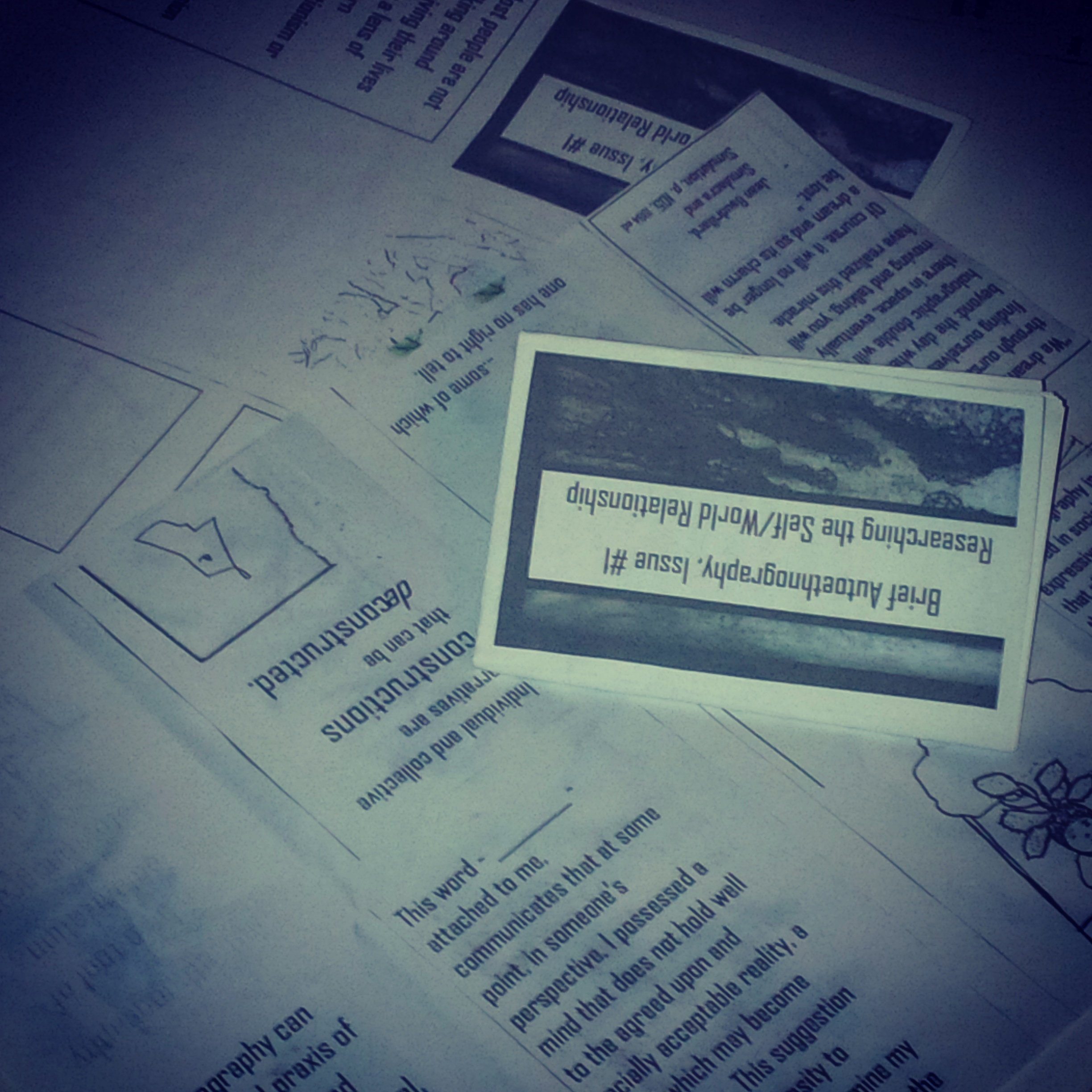
Here is the project, as it stands…a mess, in ways that are both intentional and unintentional. Parts of it are extremely problematic. This is not a six month project, this is a multi-year project. I feel like I have pulled together a tremendous heap of story and description, much of it not necessary, a great deal gratuitous. The project at this point exposes a great many shortcomings in skill and flaws in logic. My immaturity astounds me, when I am able to get a little distance from myself.
“What was I thinking?”
Now, I am thinking that it is very important to me that I take care of my thinking, that I continue to work to figure out my strengths and vulnerabilities in thought, so that – maybe – someday, I can be understood in what it is that I am trying to say, and understood in a way that matters, that has some impact, that changes the outcome.
[pdf of project will be added soon]
The past few months, working in earnest on this project, have been grueling and strange. It has been a difficult project. I almost left school, quit in the eleventh hour. I even wrote the message and looked at the withdrawal form. It is hard to face one’s limitations, and to see one’s assumptions and errors in thinking and presentation laid out there, right on the page. It is easy to think about writing a book, but actually showing something that you’ve written to another person, to try to read one’s words through different possible perceptions…well, it is harrowing and, in many ways, humiliating.
“Humiliation is good/ It means you believe in something” – Bill Callahan, Smog, Fool’s Lament
I don’t know if that is true. Maybe humiliation is good because it gives us clues as to what we believe about what is dignified and respectable, and can inform us as to how these beliefs work in our sense of self and our determinations as to whether or not we’ve failed, or done something we can be proud of.
Addendum:
|
|
May 26 (4 days ago)  |
|
||
|
||||
Several days ago, I had a conversation with the professor who supervised/signed off on this project. I did not receive much supervision, nor did I ask for much supervision. In fact, I somewhat avoided it.
It was a difficult project for me to work on. I didn’t know what I was doing. Rather, I knew enough about what I was doing to know that I wasn’t doing it right. I could conceptualize – with a sense of almost gestalt clarity, totality of detail – a quality data analysis methodology for a project such as this, but I could not carry out the methodologies that I could imagine.
In this work, I confront my current limitations in producing quality academic work, and consider my experience of anxiety in relation to these constructs of desirable formatting and conveyance of ideas within rubrics of measurable relevance.
So, I mostly kept to myself, muddling through the significance of my difficulty in producing quality, coherent academic work, drowning in a sea of self-produced narrative data and grandiose intentions, humiliating evidence of previous selves and worldviews.
I didn’t quite know what to expect in the conversation, though was calm and able to speak fairly confidently and with relative ease, remembering names.
The call came in at exactly 4:00pm, on the dot.
“Hello, Faith…” A man’s voice, that I connected with my recollection of his face and posture, his gray hair, a kind countenance, standing there in the preposterous lobby of the Westin, of all places to go to a school conference. Drinking strawberry lemonade, talking about autoethnography.
“Hi, Dr. _____.”
[brief small talk, how are you?
hope you’re well, etc.]
I sounded overly confident, “So, how do you want to…”
I stammered with the phrase “use this time”…because it sounded like something a therapist might say.
“What…do you to get out this…are, um, there any, you know, particular things you want to talk about?”
“Well,” the man’s voice said, “I just want to address a few questions and thoughts about the project and talk a little about your…future…little things…”
I laughed a little, and was surprised that I did, “Oh, yeah, little things like my future?”
“Yes, yes,” the man’s said, sounding friendly, “so…first, I want to ask you why you chose to do this particular project, why this project?”
“Okay…I…”
I was looking out the window, in the blue room at my parents’ home. It was sunny outside and everything was green and gold and blue, warm.
“I had considered several different potential projects, coming into this. I do a lot of community organizing and community building type…work…here, and so I thought about maybe putting together a participatory action research type project, and went so far as to design a potential project around organizing mental health dialogues as part of the National Dialogue on Mental Health.”
I paused, remembering what the question was.
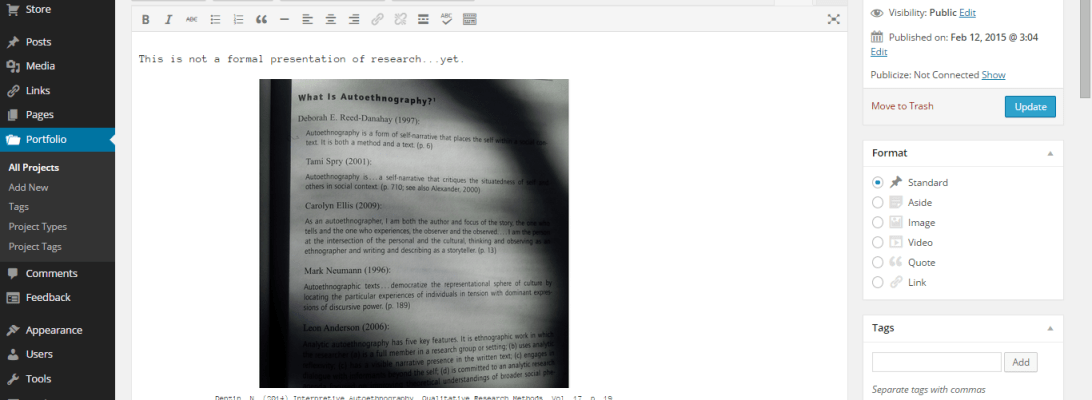
“I didn’t even learn about autoethnography until maybe this past Fall, Fall of 2014, just a few months before I started this project. I learned about the methodology through…a community group that I have been a coordinator of for the past couple of years…well…the group has been working with a researcher, Erica Fletcher, from the Institute of Medical Humanities at the University of Texas, who is doing ethnographic research, and using some autoethnographic methods in her process of analysis and reflections. I learned about the methodology through her and…when I learned about it, I felt a strong resonance, an inspiration.”
I stood at the window, and looked at the woodgrain of the sill. “You know how when you come across an idea or a theory or a practice and it just…resonates…?”
I remembered that, in the project, I written quite a bit about my relief when I learned about autoethnography, and that I had spoken with the professor about how powerful it was for me to learn about these methods of inquiry. In fact, I had written about this relief by relaying that very conversation.
I didn’t need to go on and on about it.
“I don’t know why I didn’t just do an expanded literature review or…I really probably need to do an expanded literature review, that would be a good thing to do. I need to spend some time reporting on the formal literature and developing stronger skills in referencing and citation…I…I think I might look into learning the Chicago Manual of Style method of citation, as I think it would be more compatible with how I interact with information. I have a difficult time working with the American Psychological Association style of referencing…”
“Don’t get into it, Faith.”
I told this to myself as I walked back over toward the window.
“I wanted to experiment with using autoethnographic methods, and I found myself compelled to address this particular topic of personal experience because…well, I wanted to honor the experience, and – also – I work as a peer and have been involved in…human rights and mental health advocacy movements…and I know that a lot of people experience what could be clinically called psychosis and…everyone’s experience is different…but, I…have a personal and professional interest in this topic and as an area of lived experience, it felt important that I spend some time with it….and, you know, I have all this…self-documentation, all this data…so…I wanted to explore autoethnographic methods and…”
I was pacing in the room. It was easier to talk if I was moving around, standing up.
I paused, “So…”
“Okay, yes…”
[unrecalled portion of conversation. I was standing at a bookshelf, looking at the spines of my son’s old fantasy novels, colorful and shiny…]
I paced a little bit.
“What’s your motivation for getting an MA degree? Career? Are you interested in…what? What are the benefits of getting this degree for you?”
“Well, I work as a peer in a state-funded setting. I’m certified as a peer and as an Associate Mental Health Professional, according to state-criteria. If I get my MA, I might be able to be a Qualified Mental Health Professional, and that would give me a bit of a pay increase…which would be lovely. Also, I have – ever since I was pretty young – respected higher education and been interested in…I just have always wanted to earn an advanced degree. It’s just something I value for some reason. I actually have a little bit of a…this showed up some in the project…a little bit of a conflicted relationship with the idea advanced degrees…and there might even be some resentment toward…”
I made myself stop talking.
“So,” the man’s voice asked, “why did choose to do this degree at _______?”
“I appreciate the Humanistic tradition as a branch of psychology…and_______ was actually recommended to me, by Dr. Michael Cornwall, who is a private practice therapist, but who is involved in advocating for alternative approaches to psychosis. I know some people who went there, Dr. David Lukoff and Dr. Paris Williams. I knew that I would be most successful in an interdisciplinary program, than a…hardcore empiricist…”
I fumbled, “I don’t know the words for it…” I realized that I had just said “hardcore empiricist” and that I did, in fact have the words for the sort of program that I knew I would struggle within.
“I’m interested in qualitative research and methodologies like autoethnography and narrative analysis. I felt like ______ would be a good fit…”
I walked across the room.
“I, you know…I am a little bit of a non-traditional student. I think the first graduate program…yes, the first graduate program that I was enrolled in was in 1999-2000. My education has been…um, disrupted by various life events, and so…I am learning a lot as I go along, and have some significant growth edges as a student…but, I feel like I could potentially work well in interdisciplinary programs, and in certain methodologies. I mean, my life trajectory was…derailed a few times and so…here I am at age 38, still building some occupational stability.”
[I may have added some there at the end, now – as I recollect the conversation.]
“Yes, okay…”
I waited for him to speak.
“I’d like to share some thoughts with you about your project, the project, and…”
“Okay,” I said, feeling suddenly nervous.
“Okay,” the man sounded good humored enough. I listened.
“Your project has a lot of different…pieces…there’s a lot in it, and…some of it stronger than other parts, but it’s…remarkable in many ways.”
[I am struggling to remember exactly what he said. It is easier for me to remember what I said, though I recall the basic gist of what was said to me, mostly in segments.]
“Your project could be cleaned up, and edited…parts of it could be published…it’s not in a format that is publishable now…but, you could continue to work with it and refine it.”
“Yes,” I interjected, in a slight pause, “I’ve already begun to think about how I could approach refining parts of this project and have done bit of editing already. There is a lot that could be done to strengthen it.”
My voice felt quiet, “It was a very difficult project in a lot ways. There a few different approaches I could have taken.”
“This concept of neurodiversity…you really could have spent more time on that…I mean, I think I have heard the term, and I have a vague idea of what it means, but…in the table of contents, you have this section that is about 10 pages long, but in that, you don’t spend much time on the idea of neurodiversity…”
“Yeah, I know…I caught that. I was like, ‘Wow, I didn’t explain that at all.'”
I looked down at the grass outside of the window, a full story below. I saw a cardinal fly into the bramble at the edge of the yard.
“The term came out of the autistic advocacy and activism movements…the idea that some people have different styles of cognition and sensory integration, but that these differences aren’t necessarily a disease.”
“I’m interested in exploring how that idea intersects with the experiences of people who are diagnosed with…what would be called severe and persistent mental illness.”
“Yes, well, it would be good to say more about that, to look at some of the existing ideas and…use those ideas to strengthen this project. The idea of neurodiversity is presented as being a big part of the project, and you need to spend more time on it.”
“I’m excited to work on it more. The project ended up being a bit of a…process…and working on it helped me to identify what I need to research and what I need to…develop more skill around…”
“In addition to expanding the theoretical basis of the project, and connecting it to existing work, existing theories, you need to spend some time learning more about…autoethnography as a method, and different approaches to it. Now, you seem to have some idea about different ways that autoethnography can be approached.”
I walked out of the room, listening. I was going outside. “There are lots of different approaches…some people may take…now, you take a more evocative approach, maybe drawing on the work of Ellis and other…”
I walked down the wooden stairs from the porch, a long flight of stairs, down to a juniper that cramped the walk, thinking about the passages that had most inspired me, that had most reassured me of the legitimacy and purpose of this work.
“Or you could take a more analytical approach…and people interpret these approaches in various ways, and sometimes make up new approaches…and that’s how all science works, how things grow.”
[I am growing weary of reporting on this conversation as a series of exchanges and orientation to my physical surroundings as I talked with the supervising professor. So, I am shifting to a different means of reporting on the conversation.]
The woman sat in her car, a late model import, hatchback and black, banged up a little and covered in pollen. She found the ignition key in the cupholder by the gear shift, with a cigarette lighter and a plastic fork. She turned the key to roll down the windows, and then put it back in the cupholder. It had broken off of her keyring over a year ago, and she still hadn’t lost it. Rolling a cigarette, she listened as the man spoke about the potential for her to get a Ph.D. “Some students, they are able to apply some of their MA coursework to a Ph.D. and come into the program at essays…it might be worth
It to explore what your options might be to continue this work.”
“I might take a little time off…the August residential conference…it comes at a bad time, every year. Both my children have birthdays around that time and they start school…and maybe when they’re older…I mean, they need me less now, but my youngest child is starting middle school this year and…”
“Yes, well, the RC comes at a bad time for students who are getting their Ph.Ds and teaching at other schools and, for years, we just haven’t found a way around it.”
“It’s not a good idea to take too long of a break, because you know…you take a break and then life…happens…”
“It’s possible that a Ph.D would offer you a lot more in the ways of opportunities to teach and publish and, sure, there are a lot of different ways to go about anything, and you’re going to be a lifetime learner, no matter what, it just doesn’t stop, but academic work could offer you a…sort of container in which you could pursue your curiosities and also contribute to literature around your area of interest.”
“Yes,” the woman said, getting out of the car and sitting on the grass, “that makes a lot of sense.”
“So, are you familiar with the work of Gregory Bateson and double bind theory?”
The woman made an affirmative sound: “Um hmmm…” She felt herself get excited, “Yes! Of course, double bind theory. That had something to do with all of this. This whole thing could be looked at in terms of double binds as a driver in my experience. Yes…”
She listened. “Well, when I was doing my dissertation…Gregory Bateson was my mentor and I spent quite a bit of time with his work and…are you familiar with…probably not, it’s a small book, among his first, and it’s…it’s called Percival’s Narrative and it’s the work of this man…back in the late 1900’s, who experienced what we would now call a psychotic break and he basically wrote his way through it…and…”
“That’s sort of what I did…” The woman said this quietly, feeling – suddenly – a little incredulous that she was having this conversation, with this person who seemed to understand what she was saying, what she had been trying to say. She sat in the grass beside the car and jammed a stick into the ground, digging up under the grasses.
“Yes, yes…well, Bateson looked at this man’s work and narrative and then wrote about it. You should look into getting that book…”
The conversation began to take on a lively feel, her own excitement blooming in her mind. “I could read that book and think about how it connects to this work, and write about that. I want to read that book. I want to see how Bateson approached this person’s narrative. I want to read this person’s narrative.”
She thought about how long ago the late-19th century was. “Not so long ago.”
“So, yes, you need to spend some time reading some of the work that is out there around this topic…and other people who are doing memoirs and autoethnography. There are a number of people who are doing writing about, you know, their experiences of being in the mental health system and what not and people approach it differently. One of my favorite writers who talks about their experience with, I think it was mostly severe, really tremendously difficult depression, is this person, who is a therapist and who does clinical work, but who also writes about their experience, this person Lauren Slater, who is I think in the Northeast, and she really does a wonderful job of writing about her experience. I have all her books…I’m looking around, what is the title of that one…anyway, there are a lot of people writing about these sorts of things and you can just find the styles and approaches that make sense to you, that you enjoy reading and…”
He paused, “You’ve really devoted quite a bit of attention to your experience and have spent a lot of time considering your own experience and…it’s good that you have that record, that’s something you can use and also something that other people can make use of and potentially learn from…but, it’d be good to spend some time with some of the other work that has been done in this area.”



 | Work / Projects / Offerings |